Key takeaway: Robots increasingly work alongside people, and safety is not a feature to add later — it is a fundamental design requirement that shapes how the robot is built, from its sensors and actuators to its control logic and its behaviour around humans.
Why Safety Is Fundamental
Robots are increasingly working alongside people — in warehouses, factories, and even homes — and this changes the safety requirement fundamentally. A robot that operates in a cage, away from people, has a different safety profile than one that works directly alongside them, where a mistake can injure a person.
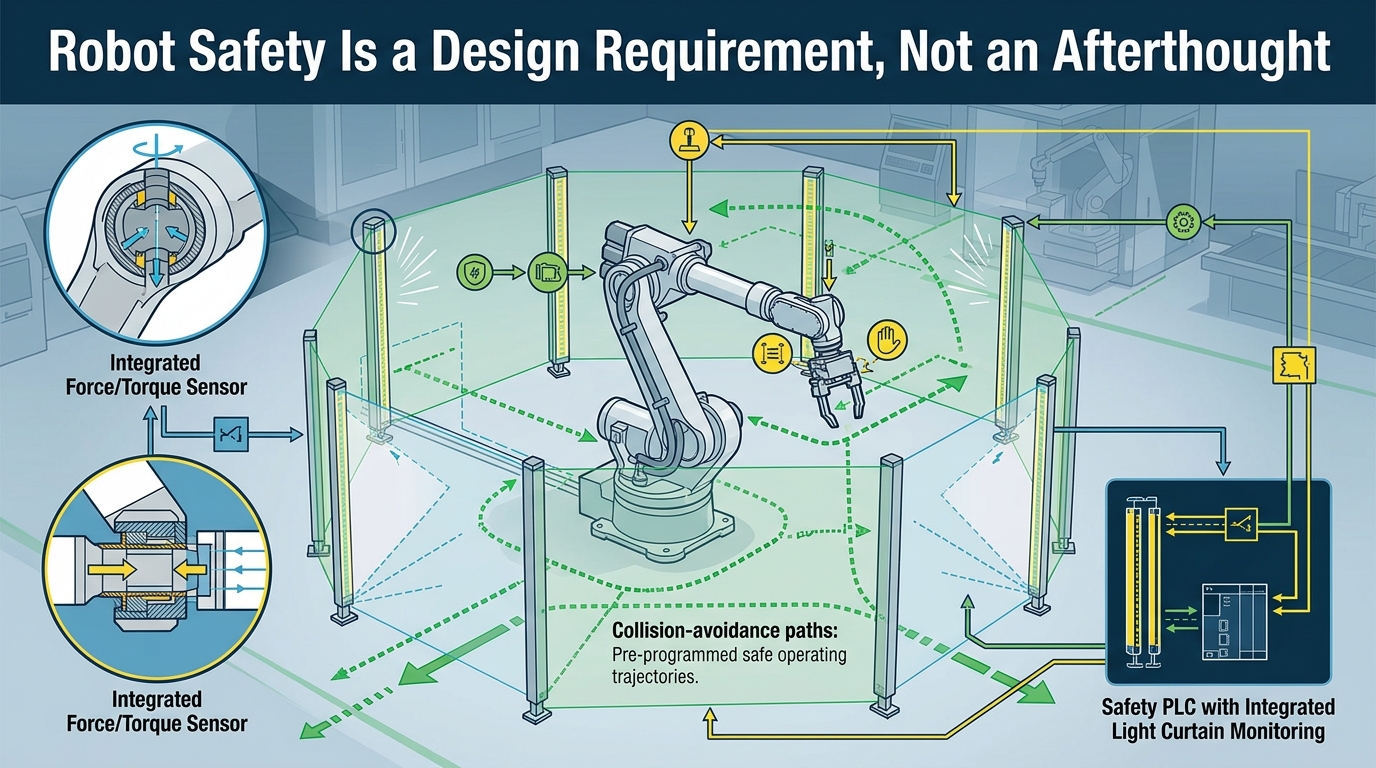
This is why safety is not an afterthought. It shapes the robot’s design from the start — the sensors it uses to detect people, the way it moves, the speed and force it is allowed to use, and the logic that decides how it behaves when a person is near.
The Elements of Robot Safety
| Element | What it involves |
|---|---|
| Sensing | Detecting people and obstacles around the robot |
| Control | Limiting speed, force, and motion near people |
| Behaviour | Deciding how the robot reacts to a person nearby |
| Standards | Meeting the safety standards that apply |
The elements of robot safety include sensing — detecting people and obstacles around the robot — and control — limiting the robot’s speed, force, and motion when people are near. They also include behaviour — how the robot reacts when a person is close — and meeting the safety standards that apply to the robot’s use.
The Standards Landscape
Robot safety is governed by standards that define what is required for a robot to be safe in different settings. These standards cover everything from the design of the robot to how it is used, and meeting them is not optional — it is a requirement for deploying a robot in most settings.
The standards are not static; they evolve as robots become more capable and more common, and as new use cases emerge. A robot designed to meet today’s standards needs to anticipate how they will evolve.
The Practical Implications
For a robotics team, treating safety as a design requirement changes how the work is organised. Safety considerations influence the choice of sensors, the design of the control system, and the testing that must happen before a robot is deployed. It also affects the timeline, because safety validation takes time and cannot be rushed.
There is also a business dimension. A robot that is not safe, or that does not meet the relevant standards, cannot be sold or deployed in most markets. Safety is therefore not just an engineering concern — it is a condition for the product to exist at all, and getting it right early is far cheaper than fixing it after a problem is found.
The Bottom Line
Treat robot safety as a fundamental design requirement, since robots increasingly work alongside people and a mistake can injure a person. Build safety into the robot from the start — the sensors that detect people, the control that limits speed and force near them, the behaviour that reacts to their presence, and the standards that apply — rather than adding it later, since safety shapes the robot’s design and is a requirement for deployment, not an optional feature.