

Quantum computers are error-prone, and error correction fixes this by using many physical qubits to represent one reliable logical qubit…
Read More »Quantum Computing

Quantum computers will not replace classical ones, and hybrid quantum computing — combining quantum and classical processors — is the…
Read More »
Just as classical computers are connected by networks, quantum devices will be connected by quantum networks, which will enable secure…
Read More »
Quantum key distribution uses the physics of quantum mechanics to secure communication, and it is one of the most practical…
Read More »
Quantum sensors use the properties of quantum systems to measure the world with unprecedented precision, and they are among the…
Read More »
Quantum annealing and gate-based quantum computing are often lumped together, but they are different tools — annealing is specialised for…
Read More »
Headlines track qubit numbers. The number that determines whether quantum computers become useful is how many physical qubits are needed…
Read More »
The algorithms are standardised. The hard part is finding every place your systems use public-key cryptography, including the parts embedded…
Read More »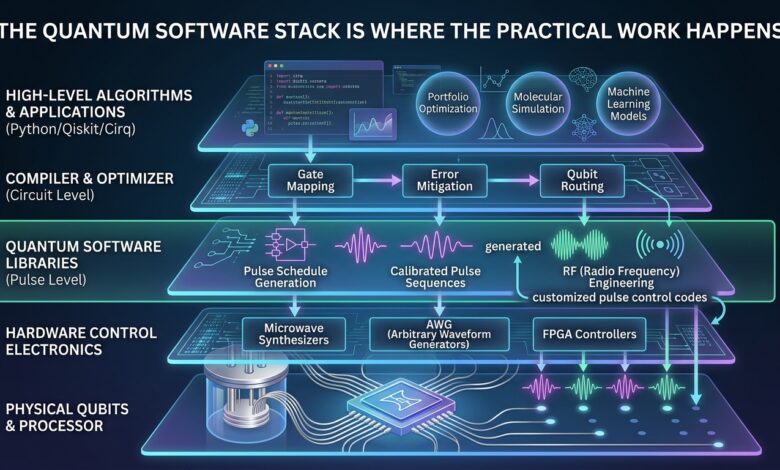
Quantum hardware gets the attention, but the software stack — the languages, compilers, and algorithms that turn a quantum computer…
Read More »