Key takeaway: Training robots in the real world is slow, expensive, and risky, and simulation lets robots learn at scale in virtual worlds before they ever touch the real one — a key to making robots capable and safe.
Why Real-World Training Is Hard
Training a robot to do a task in the real world is slow, expensive, and risky. Each attempt takes time, the robot can damage itself or its surroundings, and the number of attempts needed to learn a task can be enormous. This makes real-world training impractical for many tasks.
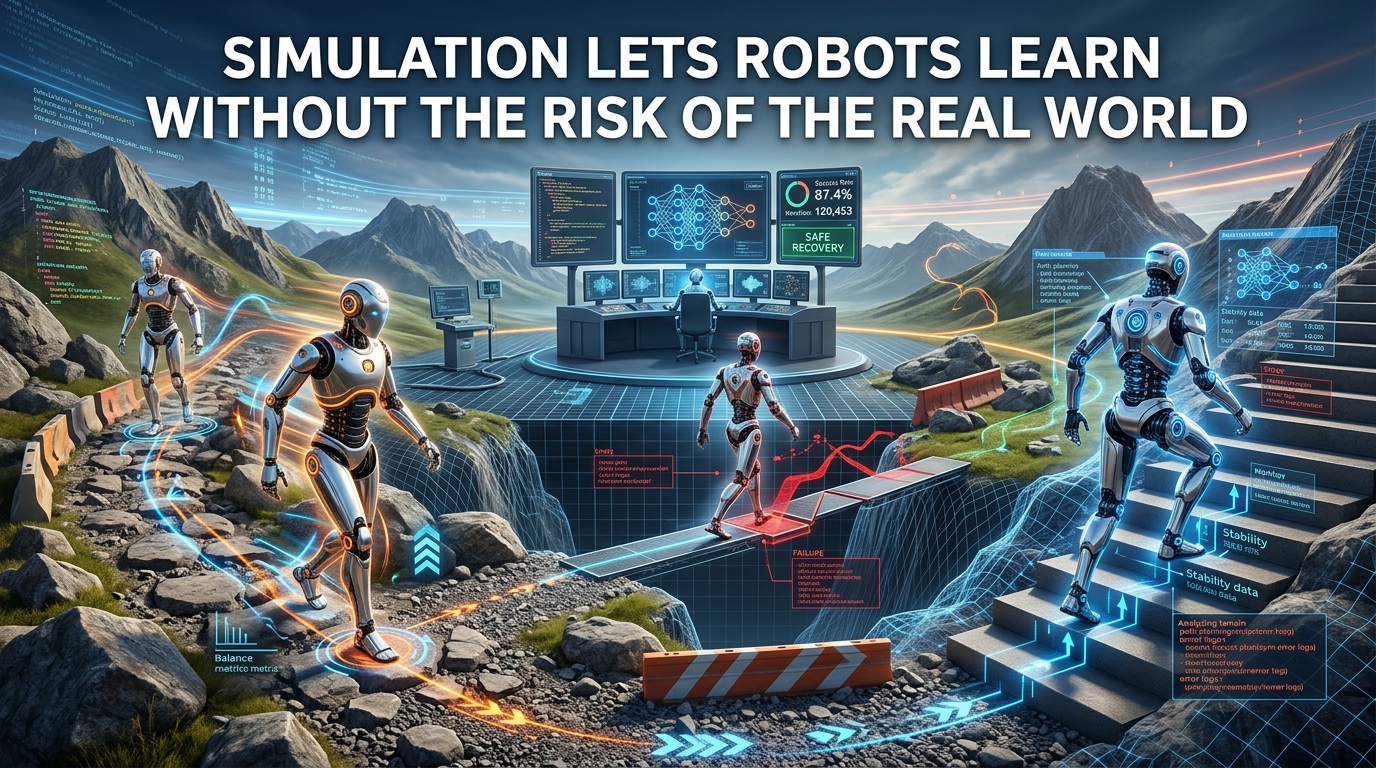
The alternative is simulation — training the robot in a virtual world that models the real one. In simulation, the robot can practise a task thousands or millions of times, quickly and safely, without the cost and risk of the real world.
The Benefits of Simulation
| Benefit | What it provides |
|---|---|
| Scale | Practising millions of times quickly |
| Safety | No risk of damage or injury |
| Cost | Far cheaper than real-world training |
| Variety | Training across many scenarios |
The benefits of simulation include scale — practising a task millions of times quickly; safety — no risk of damage or injury; cost — far cheaper than real-world training; and variety — training across many scenarios and conditions that would be hard to create in the real world.
The Challenge of Simulation
The challenge of simulation is that a virtual world is not exactly the real world. The physics, the sensors, and the objects in the simulation may differ from reality, and a robot trained only in simulation may not perform well in the real world. This gap between simulation and reality is known as the sim-to-real gap.
The field addresses this by making simulations more realistic, and by using techniques that help the robot transfer what it learns in simulation to the real world. The goal is to train in simulation and deploy in reality, with the gap as small as possible.
The Bottom Line
Understand that simulation lets robots learn without the risk of the real world, since real-world training is slow, expensive, and risky, and simulation lets robots practise at scale in virtual worlds. The benefits are scale, safety, cost, and variety, but the challenge is the sim-to-real gap — the difference between the virtual world and the real one — which the field addresses by making simulations more realistic and helping robots transfer their learning to the real world.