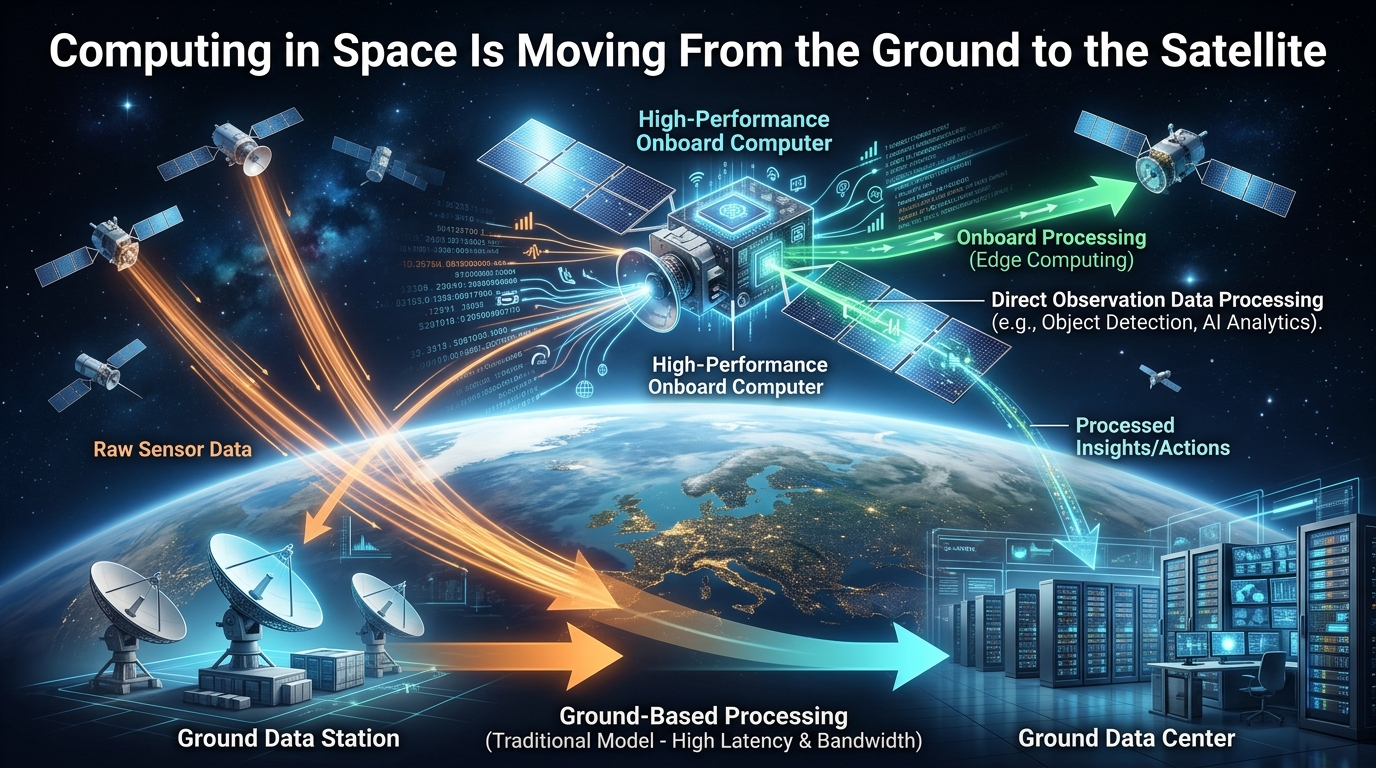
Key takeaway: Satellites have traditionally sent data to the ground for processing, but computing in space is moving processing to the satellite itself, reducing latency, saving bandwidth, and enabling new applications that need immediate results.
Why Move Computing to Space
Satellites have traditionally been simple — they collect data and send it to the ground, where it is processed. This works, but it has limits. Sending data to the ground takes time, which adds latency, and it uses bandwidth, which is limited. For applications that need immediate results, this is a problem.
Computing in space moves the processing to the satellite itself. The satellite processes the data it collects, and only sends the results to the ground. This reduces latency, saves bandwidth, and enables new applications that need immediate results.
The Benefits of In-Space Computing
| Benefit | What it provides |
|---|---|
| Lower latency | Processing data where it is collected |
| Less bandwidth | Sending results, not raw data |
| New applications | Enabling immediate, on-orbit decisions |
| Autonomy | Satellites acting without ground control |
The benefits of in-space computing include lower latency — processing data where it is collected; less bandwidth — sending results rather than raw data; new applications — enabling immediate, on-orbit decisions; and autonomy — satellites acting without waiting for ground control.
The Challenges
Computing in space is challenging. The hardware must survive the harsh conditions of space — radiation, temperature extremes, and vacuum — and it must be reliable, because it cannot be easily repaired. The computing power available in space is also limited compared to the ground.
Despite these challenges, in-space computing is growing, because the benefits of lower latency and autonomy are increasingly valuable, and the hardware is getting more capable.
The Bottom Line
Understand that computing in space is moving from the ground to the satellite, since satellites have traditionally sent data to the ground for processing, and moving the processing to the satellite reduces latency, saves bandwidth, and enables new applications. The benefits are lower latency, less bandwidth, new applications, and autonomy, but the challenges are the harsh conditions of space, the need for reliability, and limited computing power — challenges that are being addressed as the hardware gets more capable.