Table of Contents
- Why the Human Form Is Appealing
- Bipedal Locomotion Is Expensive
- Actuators Are Not Muscles
- The Power Budget Problem
- Hands Are the Actual Hard Part
- What Learned Control Changed
- Where Specialised Forms Win
- The Honest Case for Humanoids
- Common Misconceptions
- Conclusion
- Frequently Asked Questions
Key takeaway: The human body is optimised for a general-purpose forager, not for industrial tasks. Bipedal balance, human-scale hands, and human proportions each impose severe engineering costs, and specialised forms outperform humanoids at nearly every specific task.
Why the Human Form Is Appealing
The argument for humanoid robots is genuinely reasonable, which is worth acknowledging before examining where it breaks down.
Environments are built for humans. Doors, stairs, tools, vehicles, and workspaces are dimensioned for human bodies. A machine with human proportions can in principle operate in them without modification, which avoids the cost of redesigning facilities.
Task generality. One machine that could do many jobs is more valuable than many machines each doing one, particularly where task volume per job is low.
Existing demonstration data. Human demonstration can in principle teach a human-shaped machine, since the kinematics correspond.
Social acceptability. Humans interact more naturally with human-shaped machines in some contexts.
The infrastructure argument is the strongest of these. Retrofitting a warehouse, a factory, or a building for specialised automation is expensive, and a machine that works in unmodified spaces avoids it.
The counter-argument is that the human form is a compromise. Evolution optimised for a bipedal omnivore that walks long distances, manipulates objects, throws, climbs occasionally, and does all of it on roughly two thousand calories daily. None of those constraints apply to a machine, and inheriting the resulting body plan means inheriting compromises made for a different problem.
Bipedal Locomotion Is Expensive
Two legs is the most difficult practical way to move a machine, and it is worth understanding why the difficulty is fundamental rather than a matter of engineering maturity.
Bipedal walking is dynamically unstable. A standing human is continuously falling and continuously correcting, using a control loop involving vestibular sensing, proprioception, and vision, refined over years of development. Standing still is an active process.
For a machine this means:
Continuous active control. Balance requires ongoing computation and actuation. Power is consumed simply standing.
Catastrophic failure mode. Loss of balance means falling, which for a heavy machine means damage to itself and potentially to its surroundings or people nearby.
High actuator bandwidth. Correcting a developing fall requires fast, forceful responses. Actuators must be powerful and quick, which makes them heavy and power-hungry.
Sensitivity to surface conditions. Uneven ground, low friction, and unexpected compliance all threaten balance.
Payload penalties. Carrying a load shifts the centre of mass, which complicates balance and reduces the load that can safely be carried.
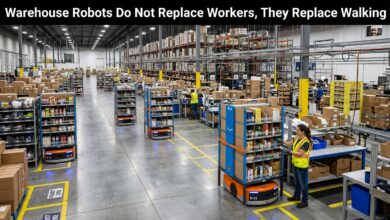
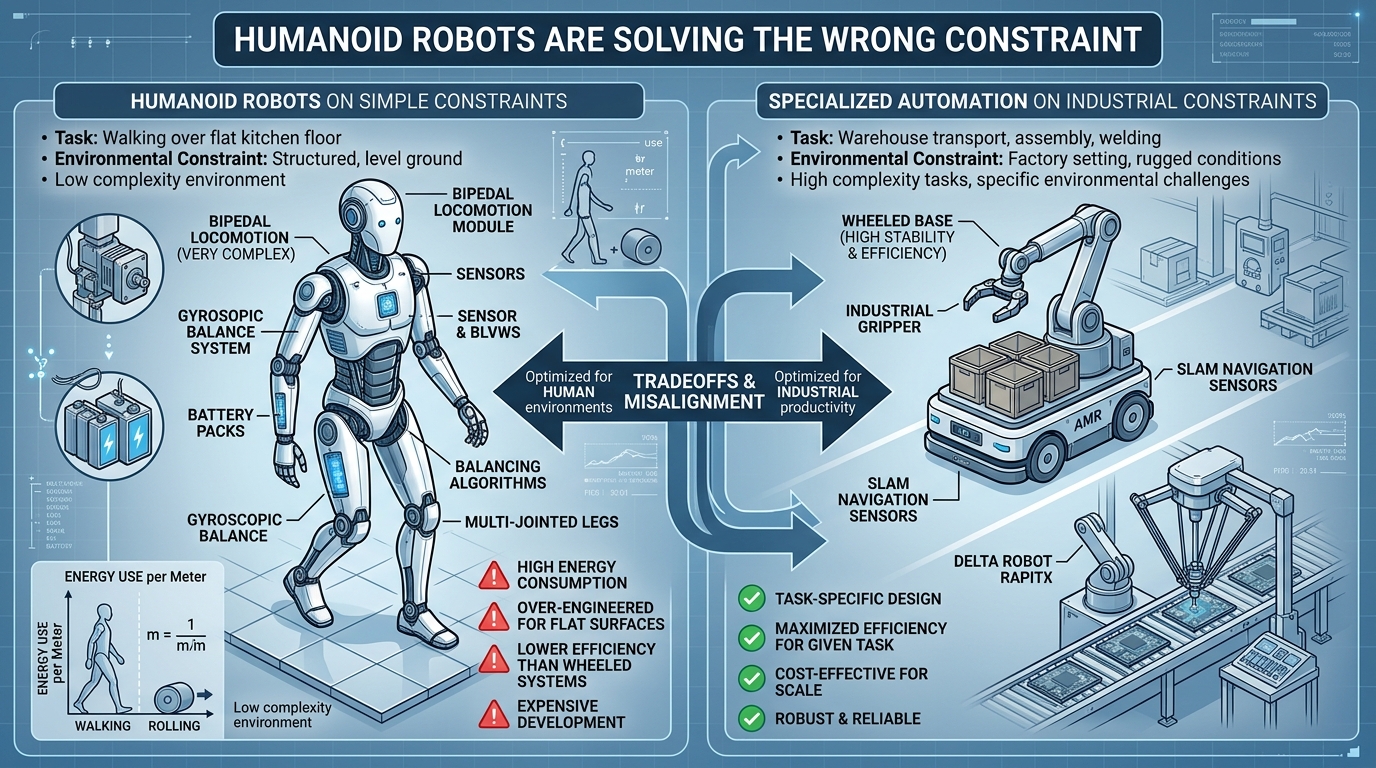
The comparison with wheels is stark. A wheeled platform is passively stable, consumes no energy standing still, cannot fall over in normal operation, and carries far more payload for the same mass and power. On flat floors — which describes the majority of industrial and commercial interiors — wheels are superior on every dimension.
Bipedal legs earn their cost specifically where the terrain requires them: stairs, thresholds, debris, and unstructured outdoor ground. That is a real category and a narrower one than general discussion suggests, and hybrid designs — wheels with articulated legs for obstacles — address much of it more efficiently.
Actuators Are Not Muscles
The comparison between biological muscle and available actuators explains many of the difficulties.
Muscle has a combination of properties that no single actuator technology matches. High power density. Inherent compliance, meaning it yields under unexpected load rather than resisting rigidly. Efficient energy storage and recovery through tendon elasticity. Force production without energy consumption at zero velocity in some regimes. Self-repair. And distributed, redundant architecture where many fibres share a load.
The available alternatives each trade differently:
Electric motors with gearing. Precise, controllable, and well understood. Rigid, which makes unexpected impacts damaging and unsafe near people. Gearboxes add backlash and weight. Torque density at low speed is poor, which is why high gear ratios are needed.
Hydraulics. Excellent power density and force. Requires a pump, reservoir, and fluid lines; leaks; noisy; and inefficient at low duty cycles.
Pneumatics. Naturally compliant, which is a genuine advantage for safety. Difficult to control precisely due to air compressibility.
Series elastic actuators. A spring between motor and load, adding compliance and enabling force sensing. Better for interaction and it reduces bandwidth and adds complexity.
Artificial muscle materials. Various approaches with promising properties in laboratory settings. None yet practical at the force, speed, and durability required.
The compliance issue is the one that matters most for machines working near people. A rigid actuator that encounters an unexpected obstacle applies whatever force it can until something breaks. Biological muscle yields. Achieving comparable behaviour requires either mechanical compliance, which costs bandwidth, or force sensing with fast control, which costs complexity — and neither fully matches what muscle does passively.
The Power Budget Problem
Energy is the constraint that most limits practical deployment, and the numbers are unfavourable.
A human performing moderate physical work consumes a few hundred watts. A humanoid robot performing comparable work consumes substantially more — the actuators are less efficient, balance consumes power continuously, and computation for perception and control adds a further load.
Battery energy density is the binding limit. Current lithium chemistry stores far less energy per kilogram than the equivalent mass of biological fuel, and the battery mass itself must be carried and balanced, which increases the power required.
The consequences for deployment:
Short operating time. Runtimes measured in a small number of hours are typical, against a work shift of eight.
Battery mass penalties. More capacity means more mass, which requires more power to move, which reduces the benefit — a diminishing return.
Charging or swapping infrastructure. Continuous operation requires either fast charging, which stresses batteries, or hot-swappable packs, which adds mechanical complexity.
Thermal management. Actuators and computation generate heat that must be dissipated from a compact, moving structure.
Peak versus average power. Sudden movements draw large currents that the battery and power electronics must supply, which sizes those components for peaks rather than averages.
This is why tethered operation appears in demonstrations and why deployed systems in practice tend to be stationary or wheeled. A wheeled platform carries a larger battery more efficiently and spends nothing on balance, which multiplies its useful operating time.
Hands Are the Actual Hard Part
If humanoid robots become useful, it will be because manipulation improved rather than because locomotion did. And manipulation is where the gap remains widest.
The human hand has around 27 degrees of freedom, dense tactile sensing across the skin, tendon-driven actuation from muscles located in the forearm rather than the hand itself, and control refined over years.
Replicating it encounters compounding problems:
Actuator placement. Motors for many joints must fit somewhere. Placing them in the hand makes it bulky; placing them remotely requires tendon transmission, which introduces friction and control difficulty.
Tactile sensing. Human skin provides pressure, texture, slip, and temperature information at high spatial density. Robotic tactile sensors have improved substantially and remain far behind in density, durability, and integration.
Force control precision. Grasping an egg and grasping a hammer require different force regulation, and getting it wrong destroys the object or drops it.
Durability. A hand is the part that contacts the world constantly. Delicate mechanisms wear out; robust ones lack dexterity.
Cost. A dexterous hand can cost a large fraction of the whole robot, and it is the component most likely to require replacement.
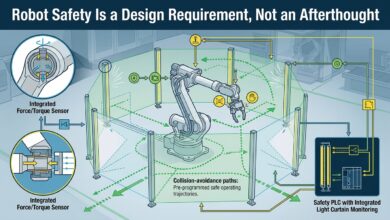
The pragmatic response in deployed systems is to abandon anthropomorphism at the end effector. Two-finger grippers, suction cups, and task-specific tools handle their intended objects better than a general hand handles anything. A machine with a simple gripper that reliably handles the twenty item types in its workflow is more useful than one with an elaborate hand that handles everything unreliably.
That observation undercuts part of the humanoid argument: if the end effector is specialised anyway, the case for human-shaped everything else weakens.
What Learned Control Changed
Recent progress is real and worth attributing accurately.
Reinforcement learning in simulation, transferred to hardware, produced locomotion controllers substantially more robust than hand-engineered ones. Machines that recover from pushes, walk on unfamiliar terrain, and handle disturbances that previously caused falls. This is a genuine advance and it explains why humanoid demonstrations improved noticeably.
Learned manipulation from demonstration has also progressed, with policies that generalise across object variation better than programmed approaches.
And vision-language models have improved the interpretation of instructions and scenes, making task specification more flexible.
What has not changed: the physics. Actuator efficiency, battery energy density, and tactile sensing density are hardware properties that better control does not improve. A robot with excellent learned balance still consumes power standing and still falls harder than a wheeled platform tips.
The distinction matters for forecasting. Control improvements have been rapid because software iterates quickly. Actuator and battery improvements are materials and manufacturing problems that move on slower timelines. Extrapolating the control curve to conclude that humanoid robots are imminent conflates two very different rates of progress.
Where Specialised Forms Win
For nearly every specific task, a purpose-built form outperforms a humanoid.
| Task | Better form | Why |
|---|---|---|
| Moving goods on flat floors | Wheeled platform | Stable, efficient, high payload |
| Repetitive assembly | Fixed-base arm | Precise, fast, no balance cost |
| Inspection in tight spaces | Snake or small crawler | Access a human body cannot reach |
| Agricultural harvesting | Task-specific mechanism | Optimised for the crop |
| Warehouse retrieval | Storage-and-retrieval system | Purpose-built for the geometry |
| Cleaning floors | Wheeled disc | Simple, cheap, effective |
| Rough outdoor terrain | Quadruped | Stable while legged |
| Working at height | Aerial or mast-mounted | Direct access |
The pattern is consistent: constraining the problem permits optimising the machine. A humanoid is a compromise across all tasks, which means it is optimal for none.
The counter-argument is task volume. Where a facility has fifty different low-volume tasks, fifty specialised machines are impractical, and one general machine — even an inefficient one — may be economically better. That argument is genuine, and it depends on the general machine being capable enough to do the fifty tasks acceptably, which is the part not yet demonstrated.
The Honest Case for Humanoids
Setting aside both enthusiasm and dismissal, where does the form plausibly make sense?
Unmodified human environments where retrofitting is prohibited or prohibitively expensive — older buildings, heritage sites, domestic interiors.
High task variety with low volume per task where specialised machines cannot be justified individually.
Operating human tools and vehicles designed around human dimensions, where a machine sized differently cannot interface.
Contexts requiring human-like social presence, which is a real if narrow category.
Places genuinely dangerous for people where a human-shaped machine can use existing equipment and access.
Research into embodied intelligence, where the human form provides a well-defined and demanding benchmark.
The credible near-term applications share a property: environments that cannot be adapted, combined with task variety that resists specialisation. That is a real category, and it is considerably narrower than “general labour.”
What would change the picture: substantially better actuator efficiency, higher battery energy density, tactile sensing approaching biological density, and manipulation reliable enough that a general hand outperforms a specialised gripper. Those are hardware advances on slower timelines than the control progress that has driven recent optimism.
Common Misconceptions
“Robots need human form to work in human spaces.” Wheeled platforms and arms already operate in human spaces successfully. Stairs and thresholds are the genuine limitation, and hybrid designs address much of it.
“Bipedal walking is nearly solved.” Locomotion control improved substantially. The energy cost and fall consequence are physical properties that control does not remove.
“Better AI makes humanoids practical.” Control has improved rapidly. Actuator efficiency, battery density, and tactile sensing are hardware constraints on slower trajectories.
“Humanoids will do general labour soon.” Manipulation reliability across varied objects remains the limiting capability, and it is the least improved.
“Human-like hands are necessary.” Specialised grippers outperform general hands at their intended tasks, which is why deployed systems use them.
“Demonstrations indicate deployment readiness.” Demonstrations are performed in controlled conditions, frequently tethered, with retries edited out. The gap to unattended operation is large.
Conclusion
The human body is optimised for a bipedal omnivore that walks long distances and manipulates objects on a modest energy budget. Copying that form in a machine inherits its compromises — dynamic instability requiring continuous active balance, a catastrophic fall mode, and proportions that limit payload — without inheriting the muscle, tendon elasticity, and tactile sensing that make the compromises work.
For nearly every specific task, a specialised form is better. Wheels beat legs on flat floors decisively, on stability, efficiency, payload, and failure mode. Fixed arms beat mobile manipulators on precision. Purpose-built grippers beat general hands on the objects they were designed for.
Recent progress is genuine and concentrated in control, where learned policies produced substantially better locomotion and manipulation than hand-engineered approaches. It has not addressed actuator efficiency, battery energy density, or tactile sensing, which are hardware constraints moving on slower timelines — and extrapolating from the control curve to imminent general deployment conflates two very different rates.
The credible case is narrower than the enthusiasm: environments that cannot be adapted, combined with task variety too high to specialise against. That category is real, and it is not general labour.
Frequently Asked Questions
Why are wheels better than legs on flat ground? Passive stability, no energy consumed standing still, no fall risk, and far higher payload for the same mass and power. Legs earn their cost only where terrain requires them.
What is the hardest unsolved problem? Manipulation. Dexterous, durable hands with dense tactile sensing at reasonable cost remain unavailable, and manipulation is what would make a general-purpose machine useful.
How long can a humanoid robot operate? Typically a few hours on battery, against an eight-hour shift. Battery energy density is the constraint, and adding capacity adds mass that requires more power to move.
Has AI progress made humanoids viable? It has substantially improved control. Actuator efficiency, battery density, and tactile sensing are hardware limitations that better control does not address.
Why do demonstrations look more capable than deployments? Controlled conditions, known environments, frequent tethering, and edited retries. Unattended operation in unstructured environments is a considerably harder problem.
Will humanoid robots enter homes? Domestic environments are the hardest case — cluttered, varied, and containing people and pets, with low task volume and high safety requirements. This is later rather than sooner.
What would make the case stronger? Actuators approaching muscle efficiency and compliance, substantially better battery energy density, and tactile sensing near biological density. All are materials and manufacturing problems rather than software ones.