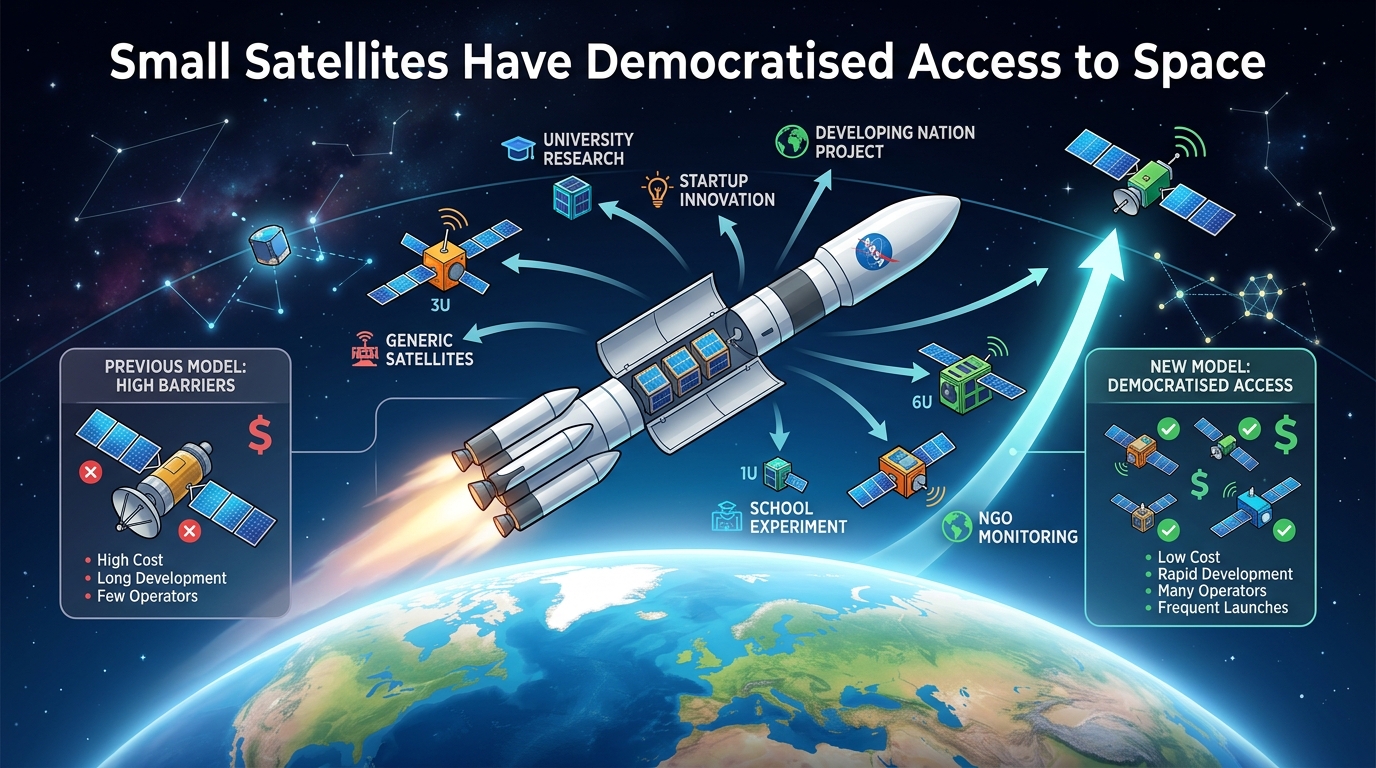
Key takeaway: Small satellites are cheaper to build and launch than large ones, and they have democratised access to space, enabling new companies and new applications — from Earth observation to communications — that were previously out of reach.
Why Small Satellites Changed Everything
For decades, satellites were large, expensive, and built by governments and a few large companies. The cost of building and launching a satellite was enormous, which limited who could access space. Small satellites changed this — they are cheaper to build and launch, and they can be produced in larger numbers.
This has democratised access to space. New companies can afford to build and launch small satellites, and new applications — from Earth observation to communications — have become possible. Small satellites have opened up space to a much wider range of participants.
The Advantages of Small Satellites
| Advantage | What it provides |
|---|---|
| Lower cost | Cheaper to build and launch |
| Faster development | Built and launched more quickly |
| Constellations | Many satellites working together |
| New applications | Enabling uses that were out of reach |
The advantages of small satellites include lower cost — cheaper to build and launch; faster development — built and launched more quickly than large satellites; constellations — many small satellites working together to provide coverage; and new applications — enabling uses that were previously out of reach.
The Trade-Offs
Small satellites have trade-offs. They are less capable individually than large satellites — they have less power, less capacity, and a shorter life. This is why they are often used in constellations, where many satellites work together to provide the capability that a single large satellite would provide.
The trade-off is between the cost and flexibility of many small satellites and the capability of a single large one, and the right choice depends on the application.
The Bottom Line
Understand that small satellites have democratised access to space, since they are cheaper to build and launch than large ones, enabling new companies and new applications that were previously out of reach. Their advantages are lower cost, faster development, constellations, and new applications, but they are less capable individually than large satellites — which is why they are often used in constellations, where many small satellites work together to provide the needed capability.