Gripping Is the Hardest Problem in Robotics, and It Is Getting Solved

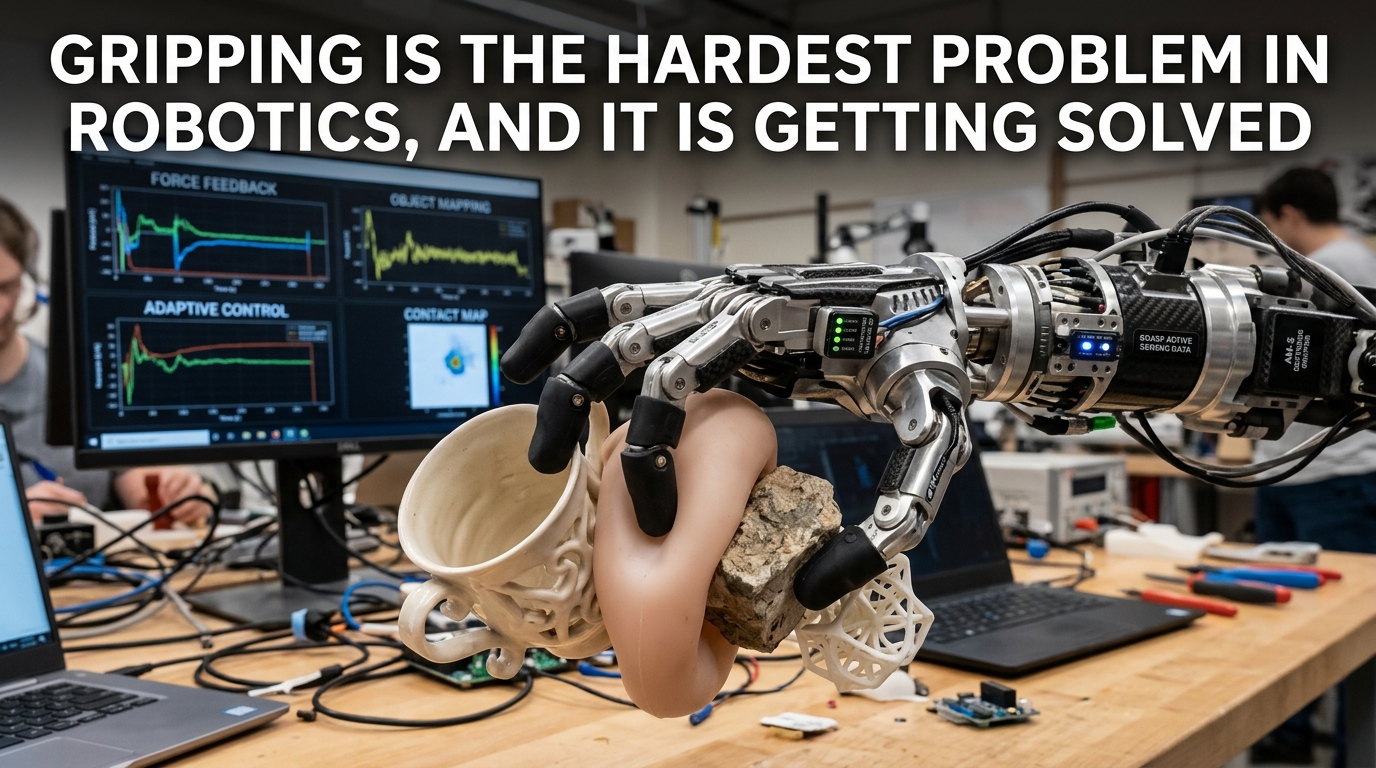
Key takeaway: Picking up and manipulating objects is deceptively hard for robots — objects vary in shape, weight, and fragility, and the robot must sense and adapt — and gripping is one of the hardest problems in robotics, now being solved with better hardware and learning-based approaches.
Why Gripping Is Hard
Picking up an object seems simple to a human, but it is deceptively hard for a robot. Objects vary in shape, size, weight, and fragility, and the robot must sense the object, decide how to grasp it, and apply the right amount of force without dropping it or crushing it. This is a hard problem, and it is one of the reasons robots have historically been limited to repetitive tasks with known objects.
The difficulty is that the real world is not predictable — objects are not always where expected, they come in endless variety, and they can be damaged by too much force or dropped with too little. A robot that can grip one object well may fail on the next.
The Approaches to Solving It
| Approach | What it does |
|---|---|
| Better hardware | Grippers that adapt to different objects |
| Sensing | Detecting the object’s shape and properties |
| Learning | Training robots to grasp from experience |
| Simulation | Practising grasping in simulated worlds |
The approaches to solving gripping include better hardware — grippers that adapt to different objects; sensing — detecting the object’s shape and properties; learning — training robots to grasp from experience rather than following fixed rules; and simulation — practising grasping in simulated worlds before trying it in the real one.
Why It Is Getting Solved
Gripping is getting solved because of advances in hardware and learning. Better grippers can adapt to a wider range of objects, and learning-based approaches let robots improve their grasping from experience, rather than relying on hand-coded rules that fail on unfamiliar objects. Simulation lets robots practise at scale, learning from many attempts without the cost and risk of real-world practice.
These advances are making robots able to handle the variety and unpredictability of real objects, which is expanding what robots can do in warehouses, factories, and beyond.
The Bottom Line
Understand that gripping is one of the hardest problems in robotics, since picking up and manipulating objects that vary in shape, weight, and fragility is deceptively hard. It is being solved with better hardware that adapts to different objects, sensing that detects an object’s properties, learning that improves grasping from experience, and simulation that allows practice at scale — and these advances are expanding what robots can handle in the real world.