Key takeaway: Quantum computers will not replace classical ones, and hybrid quantum computing — combining quantum and classical processors, each doing what it does best — is the most practical path to useful quantum computing in the near term.
Why Quantum Will Not Replace Classical
Quantum computers are powerful for certain problems, but they are not better at everything, and they will not replace classical computers. Classical computers are excellent at most tasks, and quantum computers are specialised — good at a narrow set of problems. The two are complementary, not competing.
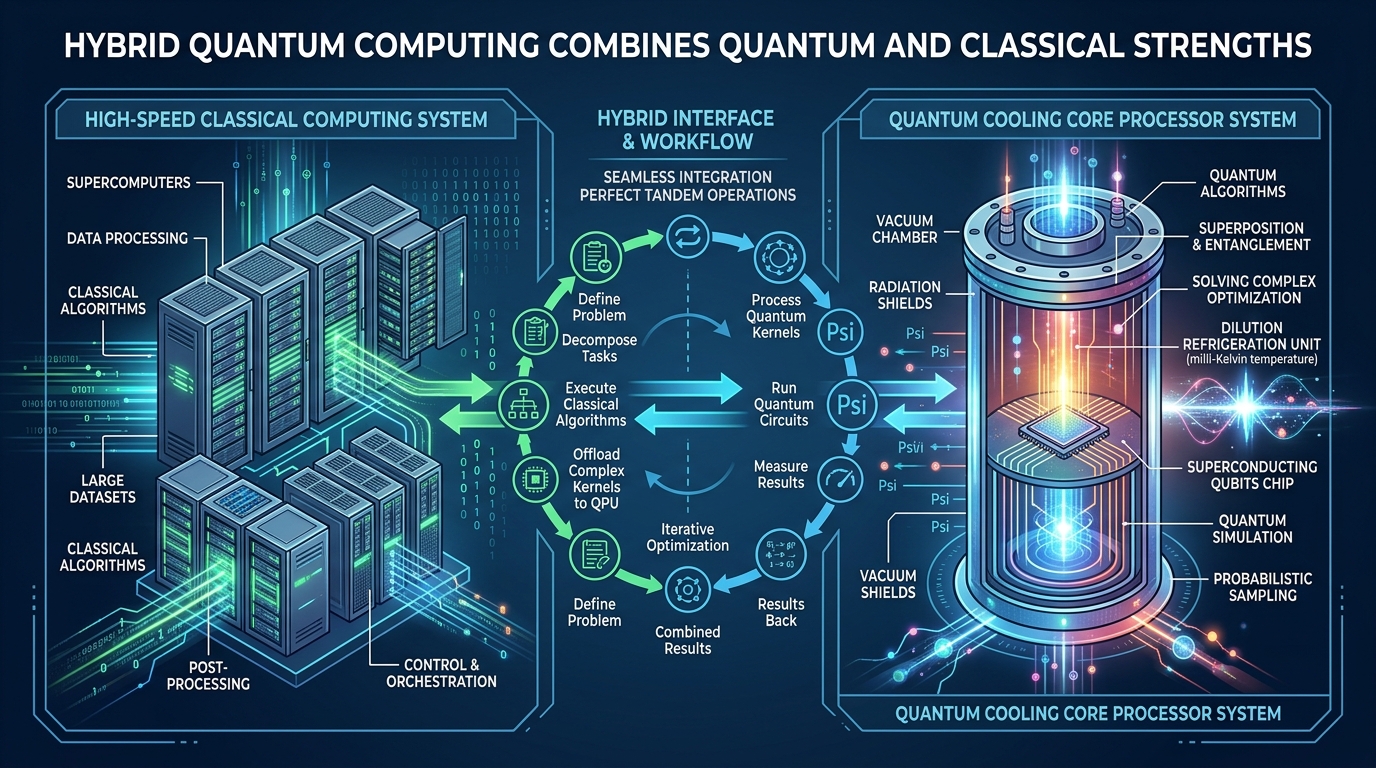
This is why the most practical path to useful quantum computing is hybrid — combining quantum and classical processors, each doing what it does best. The classical processor handles the parts of the problem it is good at, and the quantum processor handles the parts where it has an advantage.
How Hybrid Computing Works
| Component | What it does |
|---|---|
| Classical processor | Handles most of the computation |
| Quantum processor | Handles the quantum-hard parts |
| Coordination | Passing work between the two |
| Optimisation | Using each where it is strongest |
In hybrid computing, the classical processor handles most of the computation, the quantum processor handles the parts that are hard for classical computers, and the two coordinate, passing work back and forth. The goal is to use each processor where it is strongest, to get the best overall result.
Why Hybrid Is the Practical Path
Hybrid is the practical path because it works with the quantum computers available today. Current quantum computers are small and error-prone, and they cannot solve large problems on their own. But by combining them with classical computers, they can be used for parts of problems, and the classical computer handles the rest.
This makes hybrid computing the most realistic way to get value from quantum computers in the near term, while the hardware continues to improve.
The Bottom Line
Understand that hybrid quantum computing combines quantum and classical strengths, since quantum computers will not replace classical ones, and the two are complementary. In hybrid computing, the classical processor handles most of the computation, the quantum processor handles the quantum-hard parts, and they coordinate to use each where it is strongest — which is the most practical path to useful quantum computing, because it works with the small, error-prone quantum computers available today.