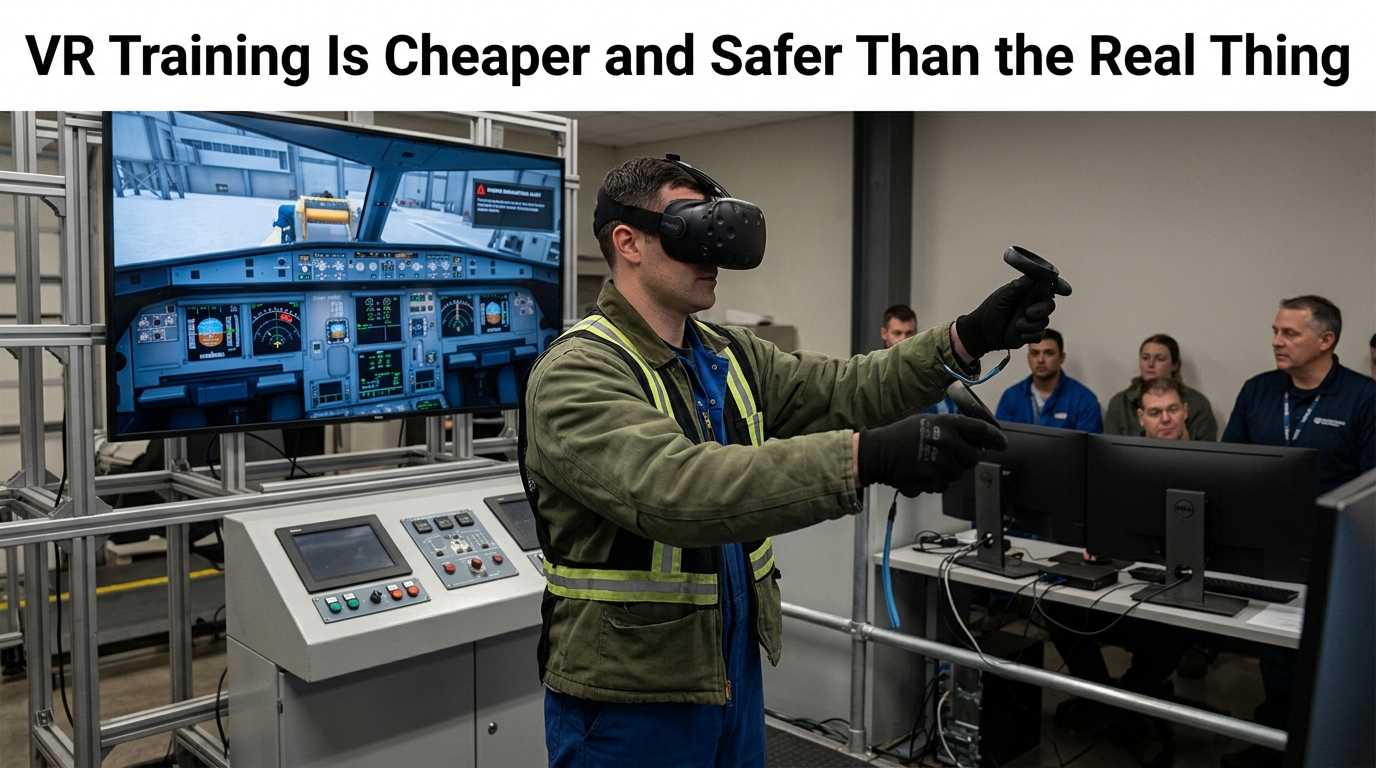
Key takeaway: Training people for dangerous or expensive tasks is costly and risky, and VR training lets people practise in a safe, virtual environment that is cheaper and safer than the real thing — and often more effective at building skills.
Why Traditional Training Is Costly
Training people for dangerous or expensive tasks is costly and risky. Training a pilot, a surgeon, or a factory worker on the real equipment takes time, uses expensive resources, and carries the risk of mistakes that could cause injury or damage. This makes traditional training expensive and limited.
VR training offers an alternative. It lets people practise in a safe, virtual environment that models the real task, without the cost and risk of the real thing. The trainee can make mistakes safely, repeat the task as many times as needed, and build skills before ever touching the real equipment.
The Benefits of VR Training
| Benefit | What it provides |
|---|---|
| Safety | Practising without risk of injury or damage |
| Cost | Cheaper than using real equipment |
| Repetition | Practising as many times as needed |
| Effectiveness | Building skills that transfer to reality |
The benefits of VR training include safety — practising without risk of injury or damage; cost — cheaper than using real equipment; repetition — practising as many times as needed; and effectiveness — building skills that transfer to the real task.
Why It Works
VR training works because it lets people practise the task in a realistic, immersive environment, and practice is how skills are built. The trainee is fully engaged, the environment responds to their actions, and they can repeat the task until they are proficient. This is often more effective than traditional training, because it provides more practice in a shorter time.
The key is that the VR environment must be realistic enough that the skills transfer to the real task, and the technology has improved enough to make this practical for many tasks.
The Bottom Line
Understand that VR training is cheaper and safer than the real thing, since training for dangerous or expensive tasks is costly and risky, and VR lets people practise in a safe, virtual environment. The benefits are safety, cost, repetition, and effectiveness — building skills that transfer to reality — and it works because it provides immersive, repeatable practice, which is how skills are built, as long as the VR environment is realistic enough for the skills to transfer.