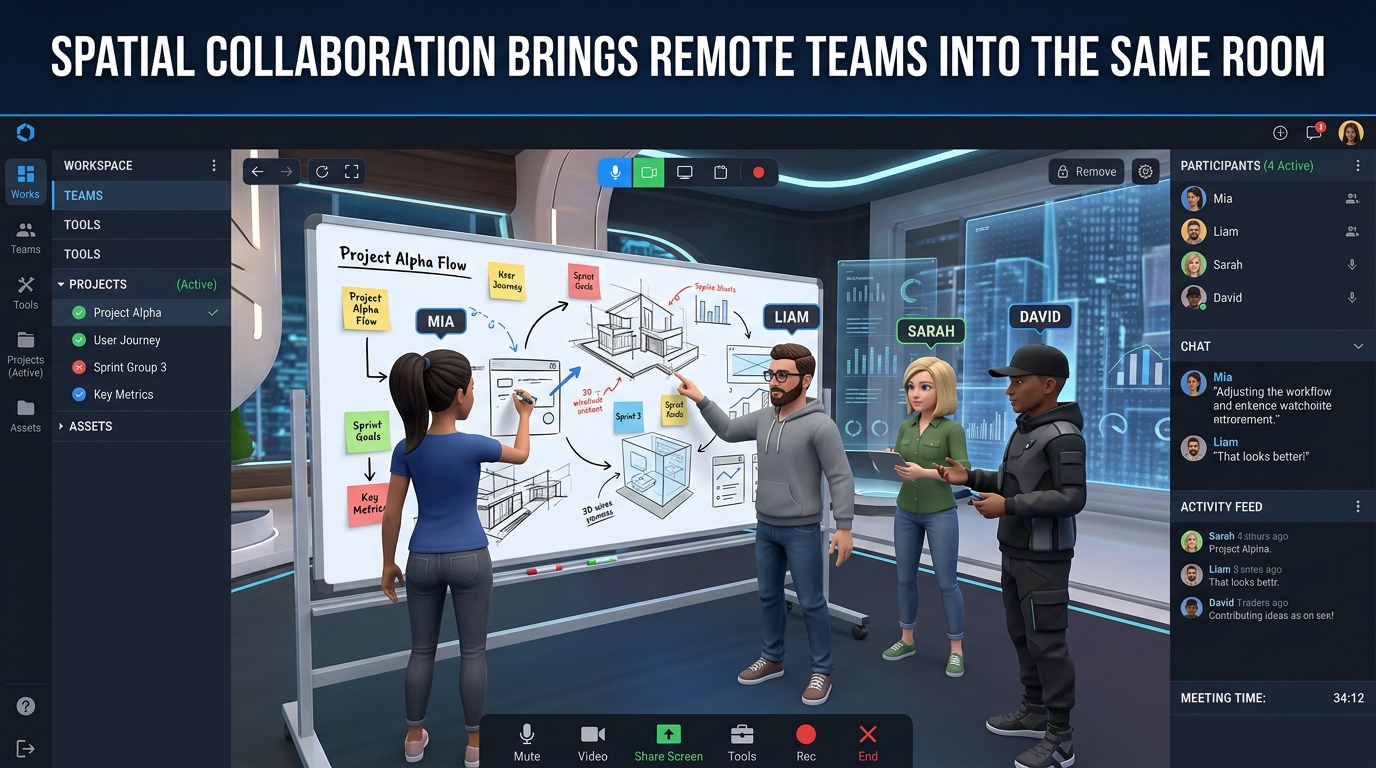
Spatial Collaboration Brings Remote Teams Into the Same Room

Key takeaway: Video calls flatten remote work into a screen, and spatial collaboration uses AR and VR to bring remote teams into a shared space, making collaboration feel more natural and effective — especially for design and review work.
The Limits of Video Calls
Remote work has relied heavily on video calls, but video calls have limits. They flatten the experience into a screen — you see faces in boxes, not people in a shared space. You cannot point at a shared object, walk around a model, or feel like you are in the same room. This makes some kinds of collaboration harder.
Spatial collaboration uses AR and VR to address this. It brings remote participants into a shared virtual space, where they can see each other, interact with shared objects, and collaborate in ways that feel more natural than a video call.
What Spatial Collaboration Enables
| Capability | What it provides |
|---|---|
| Shared space | Being in the same room virtually |
| Shared objects | Interacting with the same model |
| Presence | A more natural sense of being together |
| Better review | Reviewing designs in context together |
Spatial collaboration enables a shared space — being in the same room virtually; shared objects — interacting with the same model or design; presence — a more natural sense of being together; and better review — reviewing designs in context together, which is especially valuable for design and engineering work.
Why It Matters
Spatial collaboration matters because it makes remote work more effective for tasks that need shared context. When a team can stand around a virtual model and discuss it together, they can collaborate more naturally than over a video call. This is especially valuable for design, engineering, and other visual work.
The technology is still developing, and the hardware is not yet universal, but spatial collaboration is becoming a more important part of how remote teams work.
The Bottom Line
Understand that spatial collaboration brings remote teams into the same room, since video calls flatten remote work into a screen, and AR and VR bring remote participants into a shared virtual space. It enables a shared space, shared objects, presence, and better review — especially valuable for design and engineering work — and while the technology is still developing and the hardware is not yet universal, it is becoming a more important part of how remote teams collaborate.