Key takeaway: A digital twin is a virtual copy of a real system that stays in sync with it, and digital twins are used to monitor, simulate, and optimise everything from factories to cities — and AR and VR make them visible and interactive.
What a Digital Twin Is
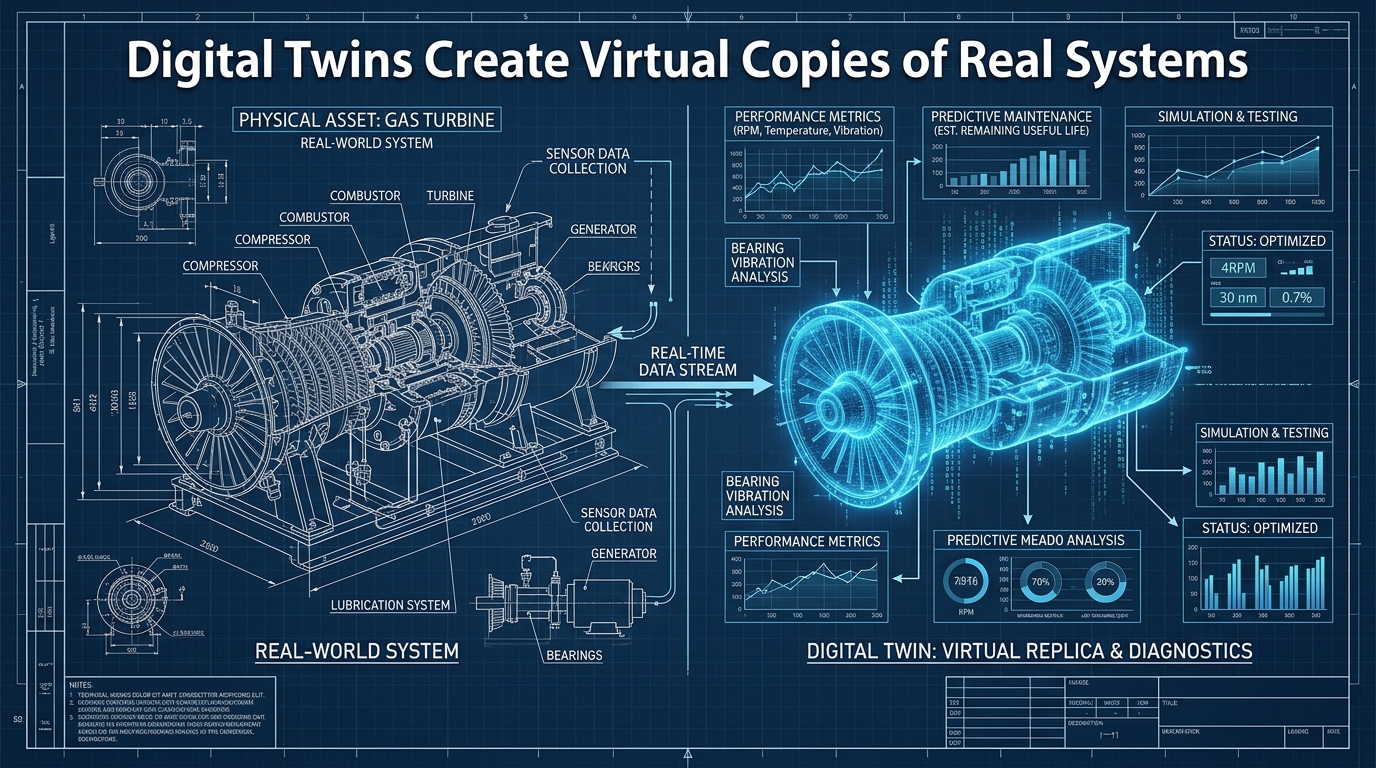
A digital twin is a virtual copy of a real system — a factory, a building, a city, or a piece of equipment — that stays in sync with the real system. Sensors on the real system feed data into the digital twin, so the virtual copy reflects what is actually happening in the real world.
This makes the digital twin useful. Because it mirrors the real system, it can be used to monitor what is happening, simulate what might happen, and optimise how the system operates.
How Digital Twins Are Used
| Use | What it provides |
|---|---|
| Monitoring | Seeing the real system’s state |
| Simulation | Testing changes without risk |
| Optimisation | Finding better ways to operate |
| Prediction | Anticipating problems before they occur |
Digital twins are used for monitoring — seeing the real system’s state in real time; simulation — testing changes without risk to the real system; optimisation — finding better ways to operate; and prediction — anticipating problems before they occur.
The Role of AR and VR
AR and VR make digital twins visible and interactive. Instead of looking at data on a screen, a person can walk through a virtual copy of a factory, see the state of each machine, and interact with the model. This makes the digital twin easier to understand and use.
This combination — a digital twin that mirrors reality, made visible and interactive with AR and VR — is powerful, and it is being used across industries to monitor and improve real systems.
The Bottom Line
Understand that digital twins create virtual copies of real systems, since a digital twin is a virtual copy that stays in sync with the real system through sensor data. They are used for monitoring, simulation, optimisation, and prediction, and AR and VR make them visible and interactive — letting people walk through a virtual copy and interact with it — which makes the digital twin easier to understand and use across industries.