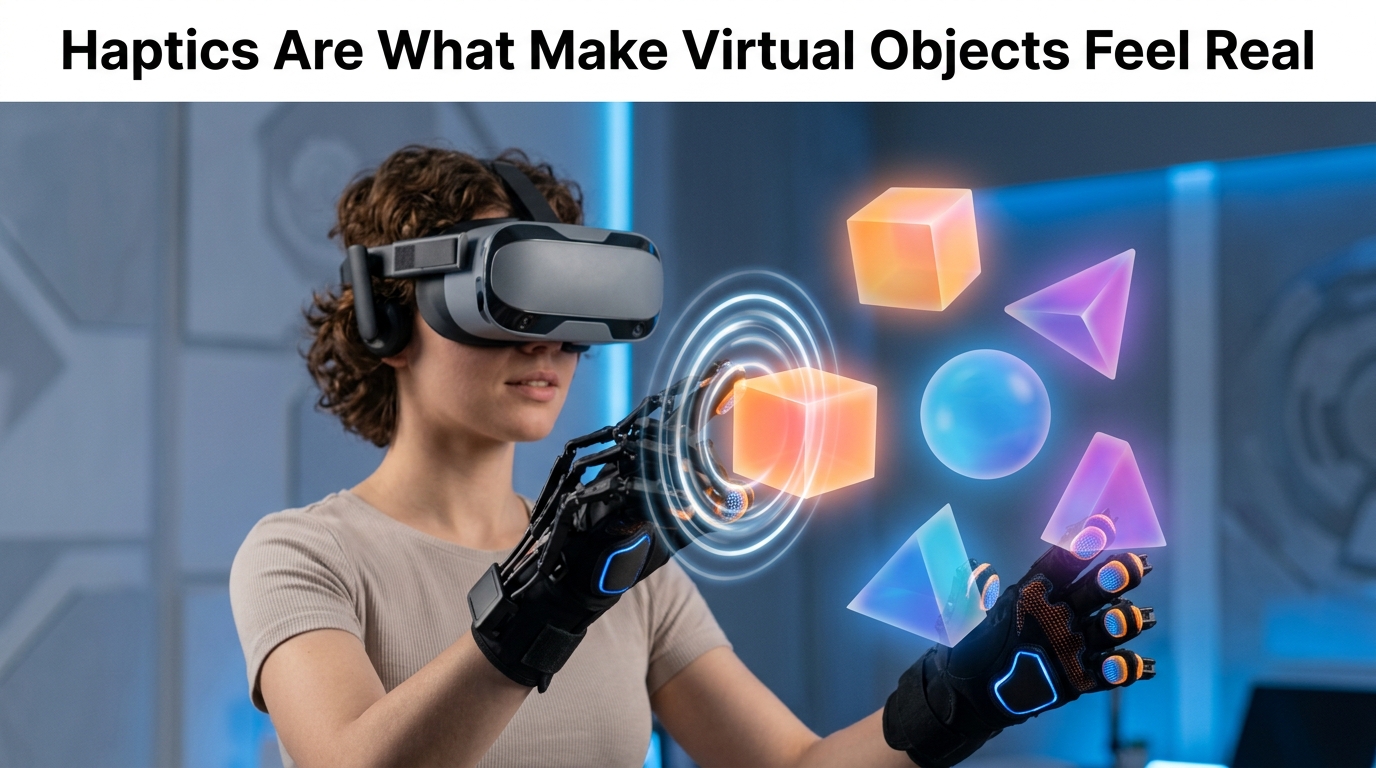
Key takeaway: Visuals make virtual worlds look real, but touch is what makes them feel real, and haptics — the technology of touch feedback — are essential to convincing virtual experiences, and they are improving rapidly.
Why Touch Matters in Virtual Worlds
A virtual world can look completely real — the graphics can be photorealistic, the lighting accurate, the motion smooth — but if it does not respond to touch, it does not feel real. When you reach out and touch a virtual object and feel nothing, the illusion breaks. This is why haptics matter.
Haptics are the technology of touch feedback — the vibrations, forces, and textures that a device produces to simulate the feel of touching something. They are what make virtual objects feel real, and they are essential to convincing virtual experiences.
The Forms of Haptic Feedback
| Form | What it does |
|---|---|
| Vibration | Simple buzzing to signal contact |
| Force feedback | Resistance that simulates weight and pressure |
| Texture | Simulating the feel of different surfaces |
| Thermal | Simulating heat and cold |
The forms of haptic feedback include vibration — simple buzzing to signal contact; force feedback — resistance that simulates weight and pressure; texture — simulating the feel of different surfaces; and thermal — simulating heat and cold. Each adds a layer of realism to the virtual experience.
Why Haptics Are Improving
Haptics are improving because of advances in the hardware and the software that drives it. The actuators that produce touch feedback are getting smaller, more precise, and more capable, and the software that controls them is getting better at simulating realistic touch. This is making haptics more convincing and more practical.
The challenge is that realistic touch is hard to simulate — it involves many sensations, and the hardware has limits. But the progress is real, and haptics are becoming a more important part of virtual experiences.
The Bottom Line
Understand that haptics are what make virtual objects feel real, since visuals make virtual worlds look real but touch is what makes them feel real, and without touch feedback the illusion breaks. Haptics include vibration, force feedback, texture, and thermal simulation, and they are improving as the hardware gets smaller and more precise and the software gets better at simulating realistic touch, making haptics an increasingly important part of convincing virtual experiences.