Key takeaway: As traditional transistor scaling slows, advanced packaging — stacking dies, connecting them densely, and integrating heterogeneous components — has become the primary way to keep improving chip performance, and it is now as important as the transistors themselves.
Why Packaging Matters More Than Ever
For decades, chip performance improved primarily through transistor scaling — making transistors smaller so more could fit on a chip. That scaling is slowing, as the physical limits of making transistors smaller become harder and more expensive to reach. This is why the industry has turned to advanced packaging as the new frontier of performance.
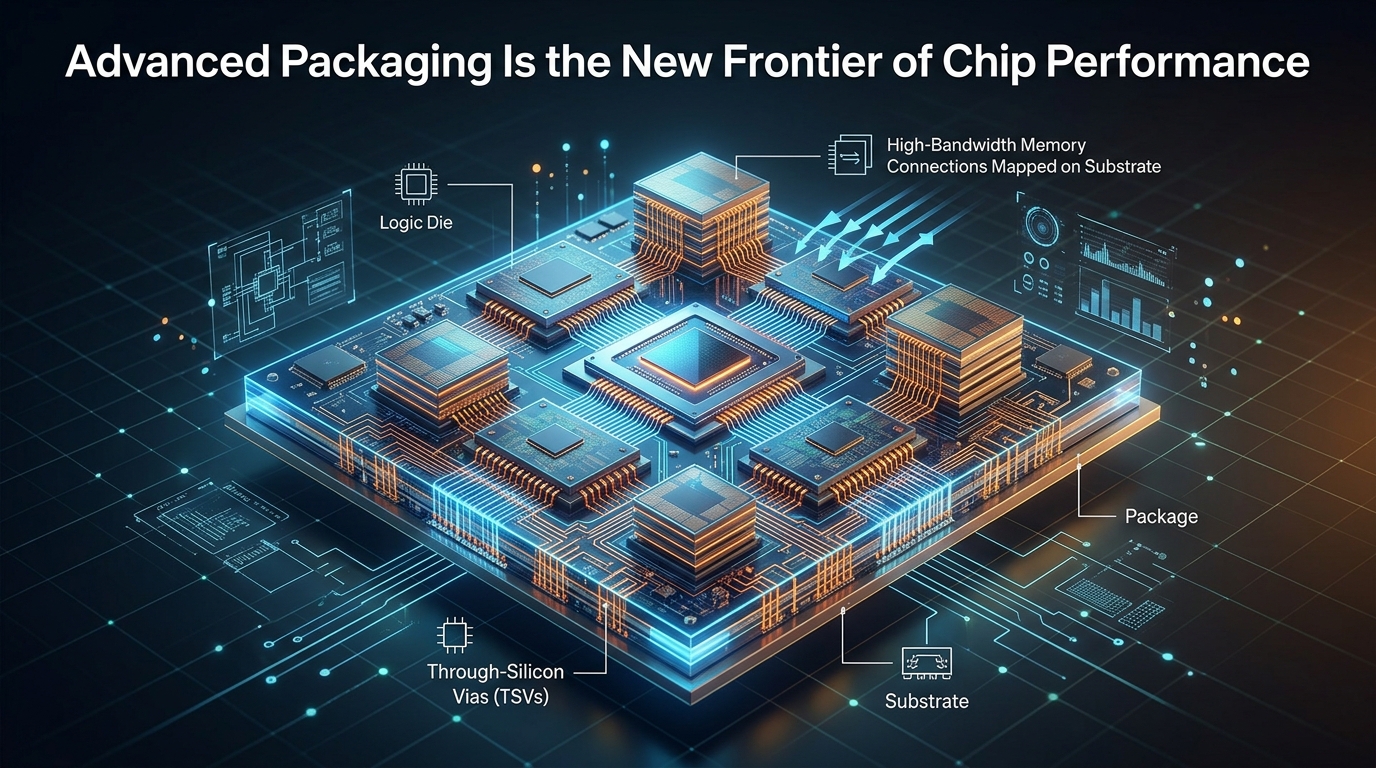
Advanced packaging is about how chips are put together — stacking multiple dies, connecting them with dense interconnects, and integrating different kinds of components into a single package. It allows chips to be built from smaller, more specialised parts, connected tightly, rather than as one monolithic piece.
What Advanced Packaging Enables
| Capability | What it provides |
|---|---|
| Chiplet integration | Building chips from smaller, specialised dies |
| Dense interconnects | Connecting dies with high-bandwidth links |
| Heterogeneous integration | Combining different process technologies |
| Stacking | Placing dies vertically to save space |
Advanced packaging enables building chips from chiplets — smaller, specialised dies that are connected together — which allows each part to use the best process technology for its job. It enables dense interconnects that move data between dies at high bandwidth, and stacking that places dies vertically to save space and shorten connections.
The Manufacturing Challenge
Advanced packaging is a manufacturing challenge as much as a design one. Connecting dies with dense interconnects requires extreme precision, and the yield — the fraction of packages that work — depends on getting the assembly right. This is why advanced packaging is a major focus of investment, and why it is a source of competitive advantage.
The challenge is that advanced packaging is hard to do well, and the companies that master it gain a real edge, which is why it has become a strategic battleground in the semiconductor industry.
Why It Matters for the Industry
The shift toward advanced packaging has broad implications. It changes where value is created in the chip supply chain, since packaging and assembly now matter as much as the design of the transistors themselves. It also changes the economics of manufacturing, because the most advanced packaging techniques require specialised equipment and expertise that not every foundry can provide.
For system designers, advanced packaging opens new options. Instead of waiting for a single monolithic chip to improve, they can combine proven dies in new ways, mixing logic, memory, and specialised accelerators in a single package. This flexibility is one reason advanced packaging has become so central to the industry’s roadmap.
The Bottom Line
Understand that advanced packaging has become the new frontier of chip performance, since traditional transistor scaling is slowing and the industry is turning to how chips are put together. It enables building chips from chiplets, dense interconnects, heterogeneous integration, and stacking — and it is a manufacturing challenge as much as a design one, which is why it has become a strategic focus and a source of competitive advantage in the semiconductor industry.