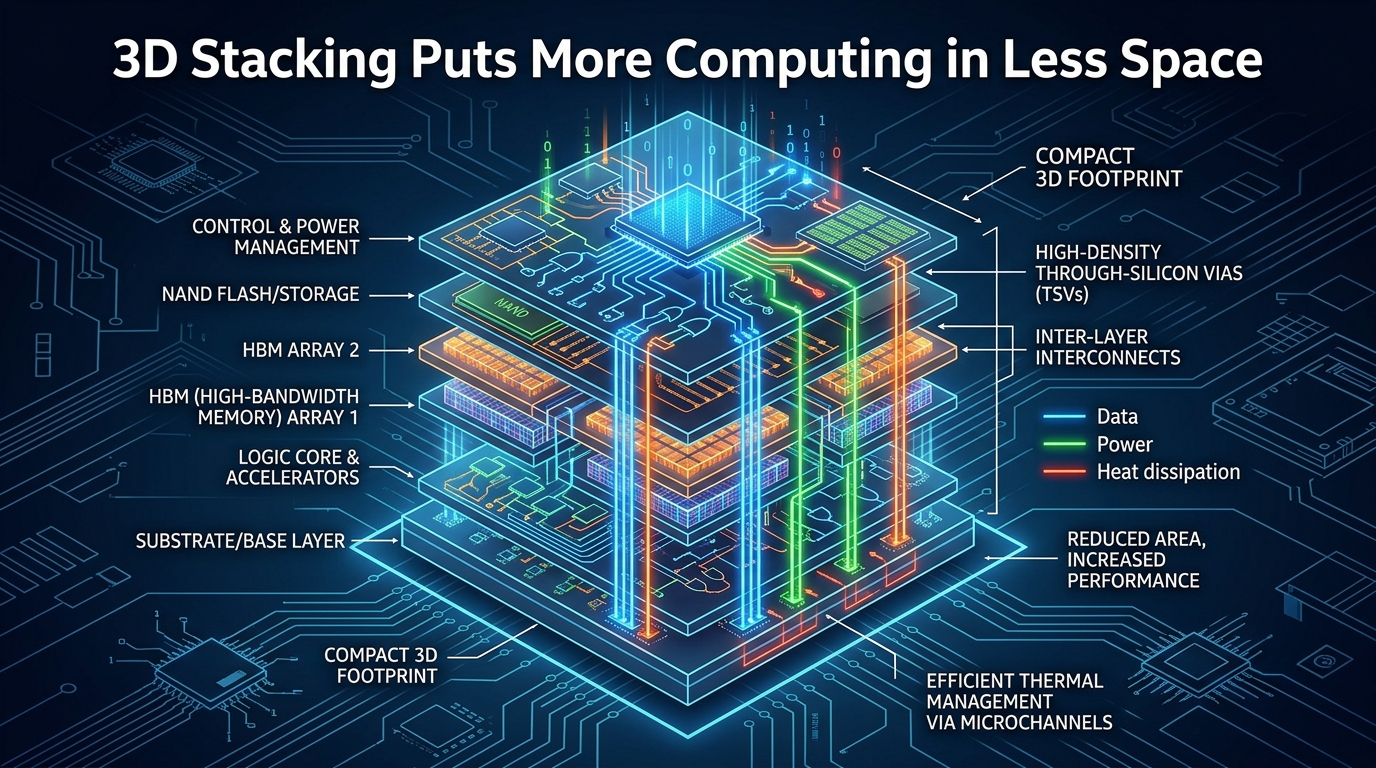
Key takeaway: Instead of making chips bigger or transistors smaller, 3D stacking builds chips upward — stacking layers of circuitry to put more computing in less space and shorten the connections between them, which improves performance and efficiency.
Why Stack Chips Vertically
Chips have traditionally been built flat — a single layer of circuitry on a piece of silicon. Making a chip more capable meant making it bigger or making its transistors smaller. Both approaches have limits: bigger chips are harder to make and use more space, and smaller transistors are increasingly hard and expensive to make.
3D stacking takes a different approach — it builds the chip upward, stacking multiple layers of circuitry on top of each other. This puts more computing in less space, and it shortens the connections between the layers, which improves performance and efficiency.
The Benefits of 3D Stacking
| Benefit | What it provides |
|---|---|
| More computing | More circuitry in the same footprint |
| Shorter connections | Faster, more efficient data movement |
| Less space | More capability in a smaller area |
| New integration | Combining different functions vertically |
The benefits of 3D stacking include more computing — more circuitry in the same footprint; shorter connections — faster and more efficient data movement between layers; less space — more capability in a smaller area; and new integration — combining different functions vertically in a single package.
The Challenges
3D stacking faces real challenges. Stacking layers requires connecting them with vertical interconnects, which is hard to do reliably, and the heat generated by stacked layers is harder to dissipate. The manufacturing is also more complex and expensive than flat chips.
Despite these challenges, 3D stacking is an important direction for the industry, because it offers a way to keep improving chips as the limits of flat scaling are reached.
The Bottom Line
Understand that 3D stacking puts more computing in less space, since instead of making chips bigger or transistors smaller, it builds chips upward, stacking layers of circuitry. The benefits are more computing in the same footprint, shorter and faster connections, less space, and new integration — but it faces challenges in connecting the layers, dissipating heat, and manufacturing complexity, which is why it is an important but challenging direction for the industry.