Memory Is the Bottleneck That Chip Design Keeps Trying to Solve

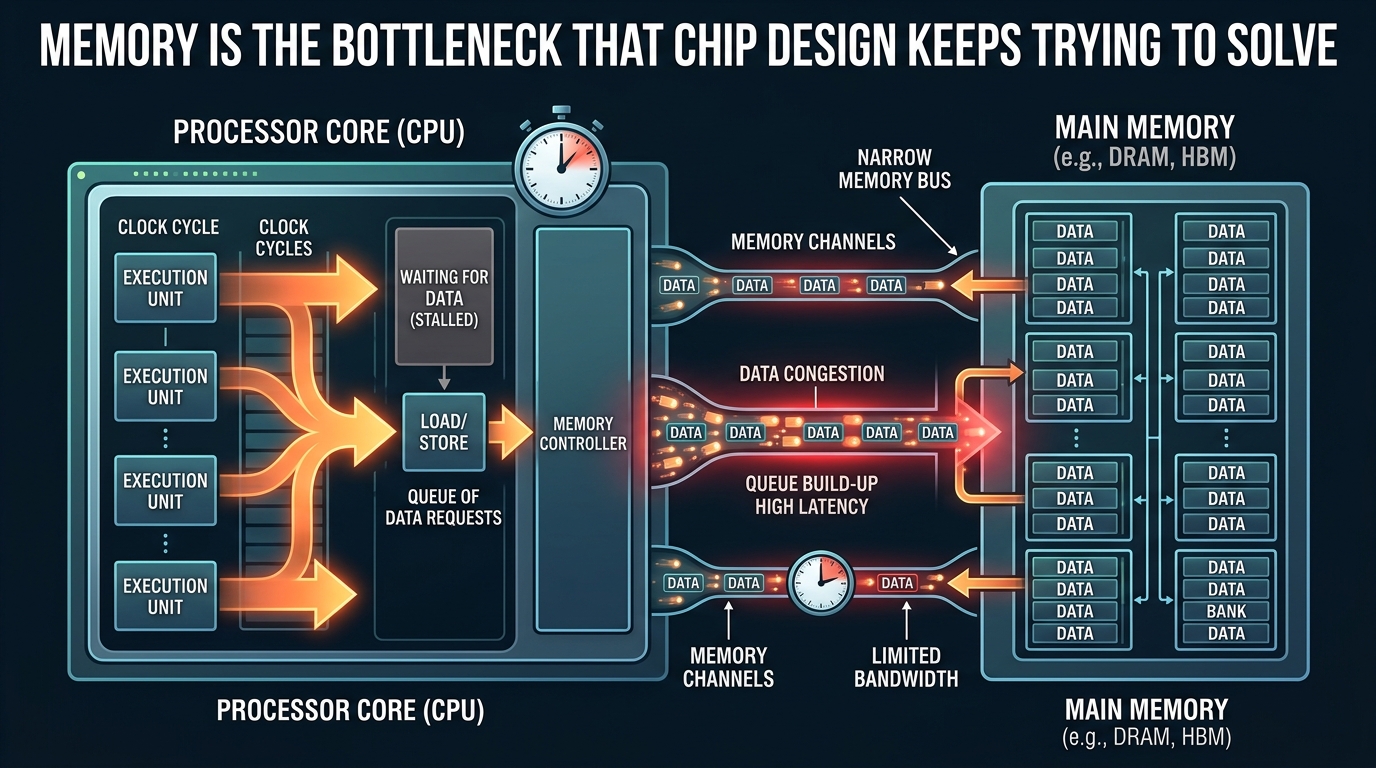
Key takeaway: Processors have gotten dramatically faster, but memory has not kept pace, and the gap between processor speed and memory speed — the memory wall — is the bottleneck that chip design keeps trying to solve, through caches, faster memory, and new architectures.
The Memory Wall
Processors have improved dramatically over the decades, getting faster and more capable. Memory has also improved, but not at the same pace, and the result is a growing gap between how fast a processor can compute and how fast it can get the data it needs from memory. This gap is known as the memory wall.
The memory wall matters because a processor that is waiting for data is not computing — it is idle. If the processor cannot get data from memory fast enough, its speed is wasted, and the memory becomes the bottleneck on overall performance.
How Chip Design Responds
| Response | What it does |
|---|---|
| Caches | Keeping frequently used data close to the processor |
| Faster memory | Using memory technologies that are quicker |
| Wider interfaces | Moving more data at once |
| New architectures | Designing around the memory bottleneck |
Chip design responds to the memory wall in several ways. Caches keep frequently used data close to the processor, so it does not have to go to main memory as often. Faster memory technologies reduce the time to get data. Wider interfaces move more data at once. And new architectures are designed around the memory bottleneck rather than assuming it away.
The Trade-Offs
Each response has trade-offs. Caches are fast but small and expensive, so they cannot hold everything. Faster memory is more expensive and may use more power. Wider interfaces take more space and energy. And new architectures may require software to change. The design problem is balancing these trade-offs to get the best overall performance.
The Bottom Line
Understand that memory is the bottleneck chip design keeps trying to solve, since processors have gotten dramatically faster but memory has not kept pace, creating the memory wall. Chip design responds with caches, faster memory, wider interfaces, and new architectures, each with trade-offs, and the design problem is balancing those trade-offs to get the best overall performance despite the memory bottleneck.