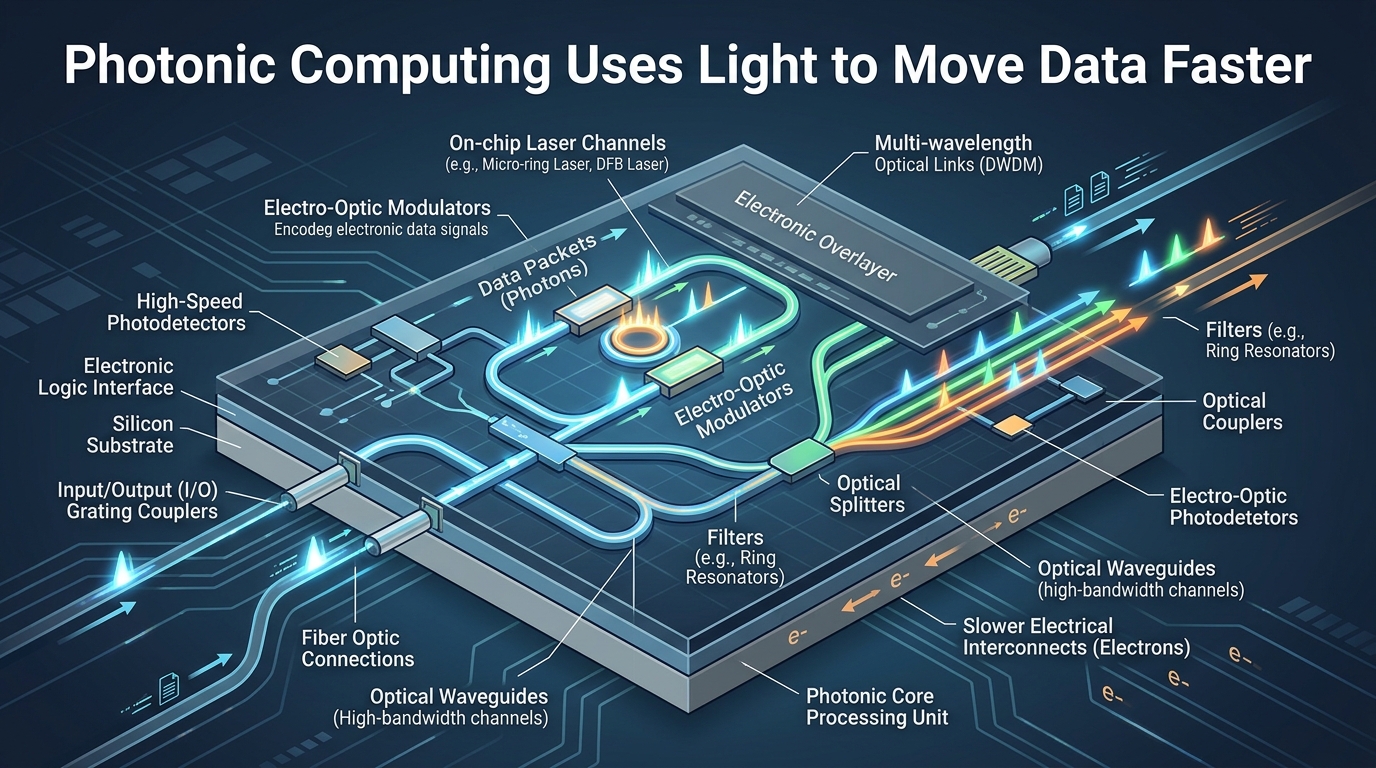
Key takeaway: Light moves data faster and with less energy than electricity, and photonic computing — using light instead of electrons to compute and move data — is emerging as a way to overcome the limits of electronic chips, especially for data movement and AI workloads.
Why Light Instead of Electrons
Electronic chips move data using electrons, and moving electrons through wires has limits — it generates heat, it is limited in speed, and it becomes harder as chips get smaller and faster. Light does not have these limits in the same way. Light moves at the speed of light, it does not generate as much heat, and it can carry more data.
This is why photonic computing — using light instead of electrons — is emerging as a way to overcome the limits of electronic chips. It is especially promising for moving data, where the limits of electronics are most acute.
What Photonic Computing Enables
| Capability | What it provides |
|---|---|
| Faster data movement | Moving data at the speed of light |
| Lower energy | Less heat than moving electrons |
| More bandwidth | Carrying more data at once |
| New architectures | Computing in ways electronics cannot |
Photonic computing enables faster data movement — moving data at the speed of light; lower energy — generating less heat than moving electrons; more bandwidth — carrying more data at once; and new architectures — computing in ways that electronics cannot, such as using light for certain AI operations.
The Challenges
Photonic computing faces real challenges. It is hard to build photonic components at the scale and cost of electronic chips, and integrating photonics with electronics is difficult. The technology is also less mature, and the tools and manufacturing processes are still being developed.
The most likely path is not replacing electronics entirely, but using photonics where it has the clearest advantage — moving data — while electronics continue to do the computing. This hybrid approach is where photonic computing is most likely to have an impact first.
The Bottom Line
Understand that photonic computing uses light to move data faster, since light moves data faster and with less energy than electricity, and photonic computing is emerging as a way to overcome the limits of electronic chips. It enables faster data movement, lower energy, more bandwidth, and new architectures, but it faces challenges in cost, integration, and maturity — so the most likely path is using photonics where it has the clearest advantage, moving data, while electronics continue to do the computing.