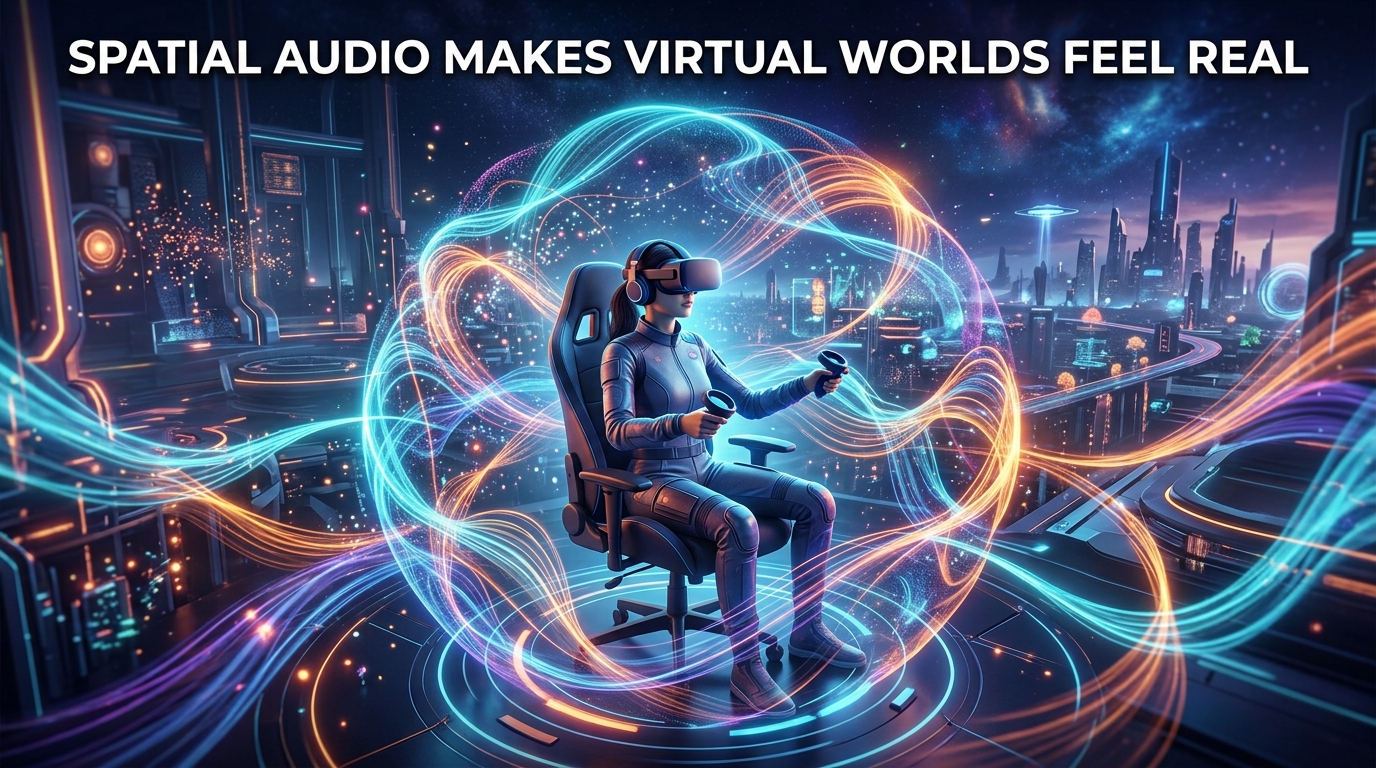
Key takeaway: Sound is a huge part of how we experience the world, and spatial audio — sound that comes from a specific place in space — is essential to making virtual worlds feel real, and it is a key part of immersive AR and VR experiences.
Why Sound Matters in Virtual Worlds
When we experience the real world, sound is a huge part of it. We hear where things are, how far away they are, and what they are doing. This spatial information helps us understand and navigate the world. Without it, the world feels flat and unreal.
The same is true in virtual worlds. For an AR or VR experience to feel real, the sound must match the visuals — it must come from the right place, at the right distance, and respond to the user’s movement. This is what spatial audio provides.
What Spatial Audio Provides
| Feature | What it provides |
|---|---|
| Direction | Sound coming from the right place |
| Distance | Sound that reflects how far away things are |
| Movement | Sound that changes as the user moves |
| Immersion | A more real and believable world |
Spatial audio provides direction — sound coming from the right place; distance — sound that reflects how far away things are; movement — sound that changes as the user moves; and immersion — a more real and believable world.
Why It Is Essential
Spatial audio is essential to immersion because our brains use sound to understand the world, and if the sound does not match the visuals, the experience feels wrong. When the audio is right, the virtual world feels real and believable; when it is wrong, the illusion breaks.
This is why spatial audio is a key part of immersive AR and VR experiences, and why it is being given so much attention as the technology develops.
The Bottom Line
Understand that spatial audio makes virtual worlds feel real, since sound is a huge part of how we experience the world, and sound that comes from a specific place in space is essential to immersion. Spatial audio provides direction, distance, movement, and immersion, and it is essential because our brains use sound to understand the world — if the sound does not match the visuals, the experience feels wrong, which is why spatial audio is a key part of immersive AR and VR experiences.