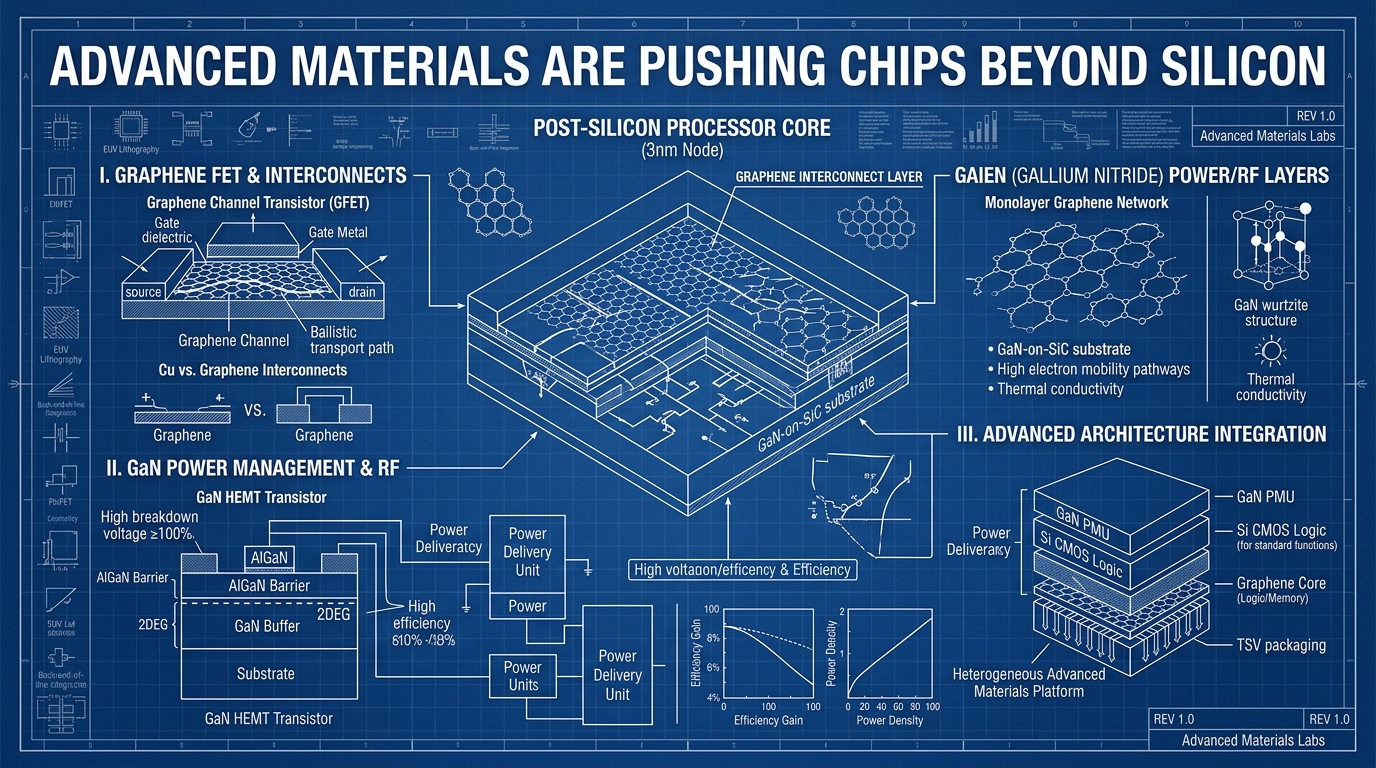
Key takeaway: Silicon has powered chips for decades, but it is reaching its limits, and advanced materials are being developed to push chips beyond what silicon can do — enabling faster, more efficient, and more capable chips.
Why Silicon Is Reaching Its Limits
Silicon has been the foundation of chips for decades, and it has served the industry incredibly well. But silicon is reaching its limits. As transistors have been made smaller and smaller, silicon is approaching the point where it can no longer be shrunk further, and its properties limit how fast and how efficient chips can be.
This is why the industry is looking at advanced materials — materials that can replace or complement silicon, to push chips beyond what silicon can do.
The Advanced Materials Being Explored
| Material | What it offers |
|---|---|
| Gallium nitride | Higher power and efficiency |
| Silicon carbide | Better for high-power uses |
| Graphene | Extremely fast and conductive |
| New semiconductors | Alternatives to silicon |
The advanced materials being explored include gallium nitride — offering higher power and efficiency; silicon carbide — better for high-power uses; graphene — extremely fast and conductive; and new semiconductors — alternatives to silicon with different properties.
Why Advanced Materials Matter
Advanced materials matter because they offer a way to keep improving chips as silicon reaches its limits. They can enable faster, more efficient, and more capable chips, and they can open up new applications that silicon cannot support.
The challenge is that working with new materials is hard. They are difficult to manufacture at scale, and integrating them with existing chip-making processes takes time. But the potential is significant, and advanced materials are an important direction for the industry.
The Bottom Line
Understand that advanced materials are pushing chips beyond silicon, since silicon has powered chips for decades but is reaching its limits, and new materials are being developed to replace or complement it. The materials being explored include gallium nitride, silicon carbide, graphene, and new semiconductors, and they matter because they offer a way to keep improving chips and open up new applications — though they are hard to manufacture at scale and integrate with existing processes, which is why they are an important but challenging direction for the industry.